
‘The illiterate of the 21st Century will not be those who cannot read and write, but those who cannot learn, unlearn and relearn.’
Alvin Toffler
I love to read and have always been curious about the how’s and why’s of things.
I get butterflies in my stomach every time the penny drops. It immediately opens up an entire ‘other’ world of unknowns. It’s the feeling of having your mind blown.

Do you remember the game mine-sweeper? Where you unlock a block and reveal an entire section of the game that was previously hidden.
Learning feels like that to me. The more I learn, the less I know.
Learning has changed since I’ve been at school.
We have entered the era of the end of INSTITUTIONS. The internet has democratised information. Knowledge is no longer on a need to know, carefully massaged, and manipulated basis. Power cannot be maintained by withholding facts. What you know, does not matter. What matters is putting wisdom into action to solve problems we don’t even know we have.
We have no idea what jobs our children need to prepare for, and the current education system, built on the back of the industrial revolution, will not create the generation that will tackle global warming, algorithmic bias, human rights violations, and global public health.
A curriculum that injects Critical Thinking, Self-Awareness, People Skills, Technology, and Data skills will!
So, where does that leave the ambitious millennial’s?
The children of Boomers.
The parents of Gen Alpha.
The managers of Gen Z.
The guys who built the internet…

Here’s how this geriatric millennial LEARNS, UNLEARNS and RELEARNS.
Firstly, you need to know your learning style.
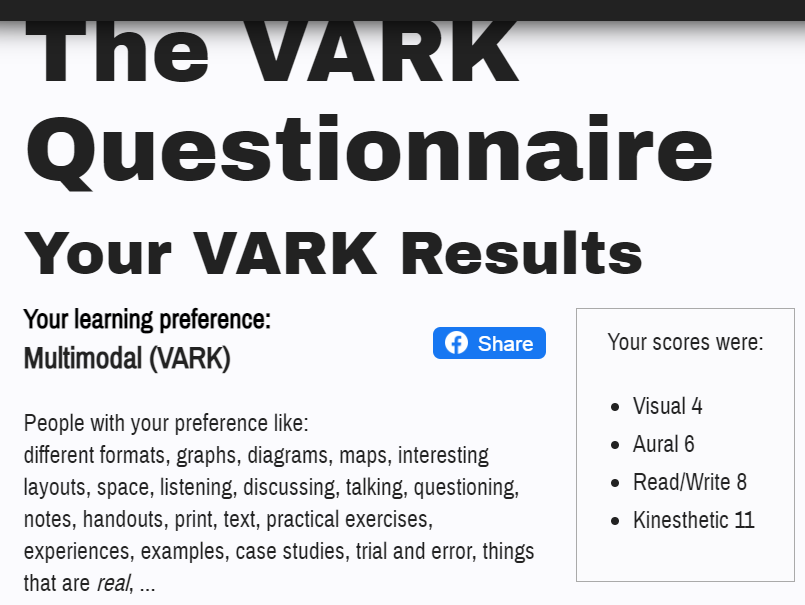
The acronym “VARK” is used to describe four modalities of student learning that were described in a 1992 study by Neil D.
- Visual Learners
- Auditory Learners
- Reading/Writing Learners
- Kinesthetic or Tactile
I am a tactile learner. In layman’s terms, I learn by doing. For me, this means engaging in the content, participating in discussions, and applying learning in my day-to-day. Follow the link to find out your learning style.
https://vark-learn.com/the-vark-questionnaire/
My favorite learning resources are listed below.
This is a rich and entertaining learning resource. The access to seasoned professionals anywhere in the world is incredible. Brilliant content creators are sharing practical insights to navigate the corporate world, entrepreneurship, and studies.
Some quick tips:
- Curate your feed. Choose the topics, creators, and hashtags you want to follow. Engaging with content and creators that add value helps the algorithm learn what to send to your feed.
- Follow and connect with thought leaders. They are humble and gracious.
- Don’t just observe. Get involved.
I currently follow the data gurus, finance business partners, finance leadership, product development, and tech. Remember, the creator does not have to be an ‘expert’ to produce valuable content. I enjoy hearing about real challenges and successes.
The feed, however, is just one part of the LinkedIn experience.
LinkedIn learning
LinkedIn learning has courses on almost any topic from hard/technical skills to soft/people skills, leadership skills and personal mastery.
You can buy courses for yourself and your team.
I enjoy this for short courses particularly on soft skills and skills outside my technical domain. I’ve learned great design skills, presentation skills, public speaking, self-mastery, personal branding and executive presence.
Here are my tips to learn for free:
- Be active on the platform. Once the algorithm knows what your interest are, courses will be recommended on your profile page. These can be unlocked for 24 hours at no cost.
- Add connections that are active and post-learning-related content. If a course is shared on your feed, you will be able to access it for free.
- Free courses are also, recommended on group pages, relevant to the groups topics and members interests.
- Use your 1 month free LinkedIn premium trial to access all learning at no cost.
- If you like a particular course creator, follow their courses and, future courses will be recommended to you
- Follow the LinkedIn learning page, search posts on the page and and access courses at no cost.
Groups and communities
Groups get a bad reputation for being boring. Some are ghost towns.
I have found a group with active, like-minded finance professionals. I often throw out questions on my mind and am met with rich, informed discussions.
It’s like having quick access to mentors, to solve real-world challenges. Check out the Finance Business Partner forum.
2. Work
Where you work is also where you learn. It’s your university. Between those walls are incredible thought-leaders, problem solvers and, resources.
The work learning portal is a great resource and should be explored. The intranet is where you can learn about business strategy, listen to executive communication and network with collegues.
But the one I love most is picking the brains of my colleagues.
- New joiners, who share industry knowledge and fresh perspectives.
- Experienced professionals
- Young talent
- Product developers
- Client facing teams
I know what you’re thinking…
‘I don’t have time.’
Your learning and development is part of work. It’s not something you do after hours. Put a plan in place, book the training, course and meetings and do it. It may slow you down at first, but it will propel you forward.
3. Udemy
There are regular sales where courses are FREE. I purchase courses of interest during the sales and I have lifelong access to them. Great for technical content. I use Udemy for data, analytics and programming.
4. The learning disruptors
This is what you’ve been waiting for.
- Microsoft learn
‘Microsoft Learn is a free, interactive, hands-on training platform that helps people develop in-demand technical skills related to widely used Microsoft products and services including, Azure, Microsoft 365, Power Platform, Microsoft Dynamics, and more.’
Anyone can register for Microsoft learn. There are free courses linked to Microsoft applications. If you are lucky, you could win a free MS exam. I am taking the PowerBI certification in a few weeks.
- Google + Coursera
‘2 Oct 2017 — Google and Coursera share a vision of equipping people worldwide with the skills they need to be job-ready. The industry-relevant curriculum is designed to take beginner learners to entry-level job readiness in 8-12 months.’
Coursera website
Google has launched an online learning platform in partnership with Coursera. For a monthly fee of 50USD, you can access some exceptional courses. Scholarships are available.
Some of the top courses are:
- Google data analytics
- Google IT support
- Google project management
- Google UX design
- Google It automation with Python
https://www.coursera.org/courses?query=google
HarvardX

YES! THE REAL HARVARD.
Free online courses from Harvard University presented by Harvard faculty members. The learning is available for free, with a cost, for the certificate. There is an interesting computer science path, that I have my eye on – CS50-Introduction to Computer Science.
A word of caution. Do not use online courses to mislead employers and recruiters. The purpose of online courses is to learn and develop skills. It is not to misrepresent yourself as an institutions alumni.
5. Honorable mentions
Professional bodies
We don’t pay those fees for a piece of paper. Check out the resources and events available on your professional bodies site.
Competitions
Competitions are great for a tactile learner like myself.
My favorites are:
- Hackathons
- The financial modeling world cup – (Follow the FMWC page on LinkedIn)
- Maven Analytics challenges- (Check out their website for challenges)
Publications and communities
- McKinsey articles – (Register and select topics of interest on the McKinsey website)
- FP&A trends digest
- Tiny Viz talks community, if you are interested in data viz.
And there you have it. That’s how I learn?
The more I learn, the more I realise how little I know. The world is grey and nuanced. Many things can be true at the same time. We can and should change often.
The problems at hand run deep and complex. It is going to take a generation of truth seekers to tackle what lies ahead.
Trust no one.
Question, everything.
XXX
 Going Brogues
You must be logged in to post a comment.